

PCN Flyaway Kit · Deployable private cellular
Your portable private 5G tower.
Bring your own private LTE/5G coverage to remote sites, with a portable tower, Sapphire radio and core, and satellite backhaul. Deploy in hours, connect authorized devices, then pack and redeploy when the operation moves.
Three cases. One private network.
Tower, radio and core, satellite backhaul: the building blocks of your own private cellular network, packed for transport. DHI provides the network and ongoing operations support.
 Case 01
Tower Kit
Portable mast, antenna and mounting hardware establish your private coverage area at the deployment site.
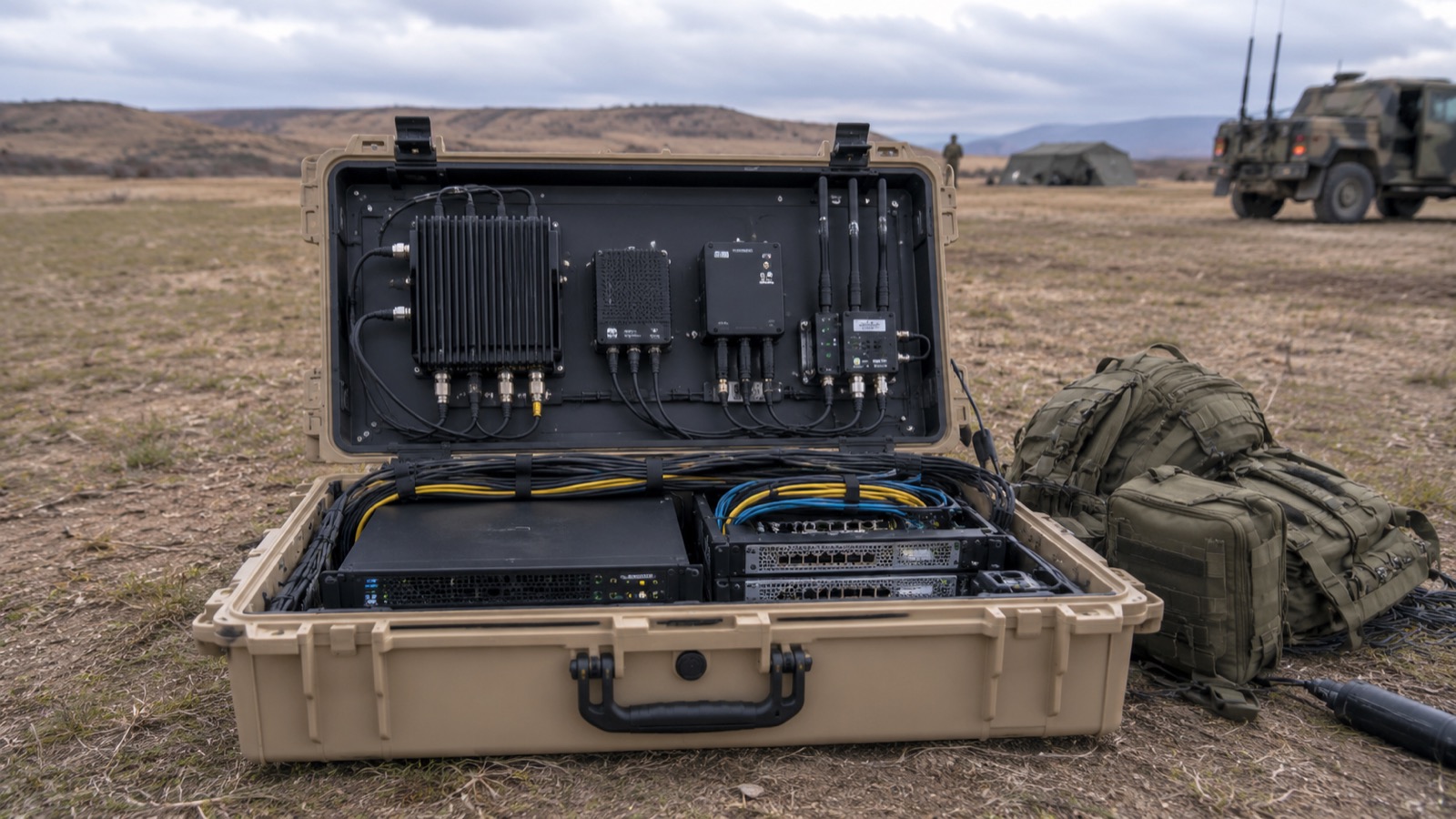 Case 02
Radio Kit
LTE/5G radio and the Sapphire core platform — the private network in a single transit case.
 Case 03
Satellite Kit
LEO satellite backhaul connects the site onward without an existing local mobile tower or fiber line.
Unpack. Configure. Activate. The Sapphire platform in three transit cases, with hours to service and 24/7 Global NOC support.
Private coverage without a permanent build
Your own tower and private access network, with satellite backhaul for remote sites. Site power, radio coverage and satellite placement are planned for the deployment.
Your private cellular network · Authorized access only
Approved SIMs and eSIMs connect compatible devices to your network.
Private LTE/5G coverage, device authentication and traffic policies operated by DHI.
LEO satellite connects the site onward without an existing local mobile tower or fiber line.
Site power and a suitable satellite view are part of deployment planning. Voice services, device support and traffic routing follow the agreed network configuration.
Coverage before infrastructure exists
Temporary bases
Early-entry sites can establish governed coverage before permanent infrastructure is available.
Training & ranges
Remote and dispersed areas get governed mobile service without a permanent build.
Surge & contingency
When infrastructure is disrupted, the Flyaway Kit replaces it in hours — not weeks.
Forward support
Contractors and support missions get governed access with proper segmentation.
The same posture — in the field.
Identity-based access, traffic segmentation, and separation from DoD mission systems — from day one, on day-one infrastructure.
Expeditionary doesn't mean exempt.
The kit enforces the same policy engine as a permanent installation. Every connection is authenticated, segmented, and visible to the operator from the first hour of service.
F1 Identity-based access
SIM/eSIM authentication from the first connection. Access granted, changed, or revoked centrally — even in the field.
F2 Segmentation
Distinct traffic domains for personnel, contractors, and support missions — each with its own policy, from day one.
F3 Mission-system separation
Physically and logically separate from DoD mission networks. Personal traffic never routes across NIPR, SIPR, or other mission systems.
Deploy the kit. Scale the installation.
Two form factors, one platform. The kit deploys today; the permanent PCN scales the installation — with no re-enrollment.
| Dimension | Flyaway Kit | Permanent PCN |
|---|---|---|
| Time to service | Hours — same day | Survey-driven build cycle |
| Infrastructure | Portable mast, radio/core and planned site power | Towers, sector radios, indoor systems |
| Backhaul | LEO satellite, built in | Fiber, satellite, or hybrid |
| Platform & identity | Same core, policy, SIM, and app | Same core, policy, SIM, and app |
| Operations | DHI Global NOC, 24/7 | DHI Global NOC, 24/7 |
Unpack. Connect. Redeploy.
Arrive & site check
Position the cases, confirm power and placement for mast and satellite terminal.
Stand up the radio
Erect the mast, mount the antenna, and bring the LTE/5G radio online.
Activate core & policy
Sapphire core up, segmentation and traffic policy enforced from the first connection.
Enroll users
SIM/eSIM profiles issued; users connect the same day with the standard Sapphire app.

Managed from day one
DHI's Global NOC monitors the Flyaway Kit 24/7 — remote management, real-time alarms, and fault isolation. Deployment responsibilities are agreed during site planning.
Request a briefingCoverage designed for your deployment
The kit creates a private cellular coverage area around its tower. DHI defines that area for your site and equipment, rather than applying a generic tower radius.
Request a briefing
Permanent infrastructure or rapid-deploy? An engineer will walk your team through the kit, the platform, and the path to a permanent build.